Expo 2020 Dubai Legacy: Expo City & Business Setup
When Dubai hosted Expo 2020 – the first World Expo in the Middle East, Africa, and South Asia – from October 2021 to March 2022, it proved to be far more than a six-month global gathering. It became a defining inflection point for the UAE economy. Now, several years on, the legacy of Expo 2020 continues to shape investment, infrastructure, and business opportunity across the country.
This article examines what Expo 2020 achieved, how it transformed the UAE across multiple sectors, and what entrepreneurs and investors need to understand about the ongoing economic legacy – particularly Expo City Dubai and District 2020 – heading into 2026.
What Was Expo 2020 Dubai?
Expo 2020 Dubai was the 33rd edition of the World Expo, held under the theme ‘Connecting Minds, Creating the Future.’ Originally planned for October 2020, the event was postponed by one year due to the COVID-19 pandemic and ultimately ran from 1 October 2021 to 31 March 2022 – a 182-day event across a purpose-built 4.38 square kilometre site in Dubai South, located between Dubai city and Abu Dhabi near the Al Maktoum International Airport.
The UAE was awarded hosting rights in 2013, beating competition from Brazil, Russia, South Korea, and Turkey. From that point, the country invested heavily in infrastructure, construction, and visitor experience, setting the stage for what would become one of the most successful World Expos in history.
The event welcomed 192 participating countries and attracted 24.1 million visits across its six-month run. Unique to Expo 2020 was its hybrid model – physical attendance combined with extensive digital engagement – which was in part a response to the lingering effects of COVID-19 and in part a deliberate strategy to globalise participation beyond physical attendees.
The Three Pillars of Expo 2020
Expo 2020 was structured around three thematic districts, each representing a core pillar of human progress:
- Opportunity District: Focused on economic development, entrepreneurship, and creating pathways to growth for individuals and nations.
- Sustainability District: Centred on environmental stewardship, climate action, and the development of a circular economy – home to the UAE Pavilion and the stunning Al Wasl Plaza.
- Mobility District: Dedicated to innovation in transportation, logistics, and the movement of people and goods across borders.
These themes were not merely symbolic. They shaped the national pavilions, the programmes, and the long-term economic direction that the UAE has continued to pursue in the years since.
Is the UAE Your Next Business Hub?
From innovation zones to sustainability districts, Expo 2020's legacy built the UAE's most dynamic business ecosystems. Find your entry point.
Sector-by-Sector Economic Impact of Expo 2020
1. Real Estate and Infrastructure
The most immediate economic stimulus of Expo 2020 was in construction and real estate. The UAE government invested billions of dirhams in building the Expo site itself – pavilions, plazas, transport links, hotels, and residential developments. The Dubai Metro Route 2020 extension, connecting Jebel Ali to the Expo site, is the most visible infrastructure legacy of the event.
According to the Ernst and Young (EY) economic impact assessment published in March 2023, construction contributed AED 31.9 billion in gross value added (GVA) over the full 2013 to 2042 lifecycle. This includes not just the Expo site itself but all the ancillary residential, commercial, and logistical developments triggered by the event.
Property developers and investors responded to the Expo opportunity in force. New hotel rooms, serviced apartments, and residential units were added across Dubai South and surrounding areas. Post-Expo, the Dubai South masterplan continues to attract real estate investment, with Expo Village offering residential living within the broader Expo City Dubai ecosystem.
2. Tourism and Hospitality
Tourism was the single largest beneficiary sector of Expo 2020. The event attracted visitors from across the world during its six-month duration, reinvigorating a hospitality sector that had suffered significantly during the pandemic years of 2020 and 2021. The EY report confirmed that restaurants and hotels contributed AED 23.1 billion in GVA over the full lifecycle of the project.
Expo 2020 came at a critical moment for UAE tourism. International arrivals had collapsed during COVID-19 and the Expo served as a powerful global signal that Dubai was open for business, safe to visit, and ready to welcome the world. The diversity of entertainment, cultural experiences, cuisine, and business networking events across the six months created a sustained visitor economy that benefited hotels, restaurants, transport operators, and tour providers alike.
The legacy effect on tourism has continued. Dubai has since hosted major global events – including COP28 in 2023 at Expo City Dubai – reinforcing its position as a leading international events and tourism destination. According to the Dubai Department of Economy and Tourism (DET), Dubai welcomed 19.59 million international overnight visitors in 2025, a 5% year-on-year increase and the emirate’s third consecutive record-breaking year for international arrivals. Average hotel occupancy reached 80.7% in 2025, up from 78.2% in 2024, with average daily rates rising 8% to AED 579 – confirming that the Expo 2020 legacy continues to underpin Dubai’s sustained growth as a global tourism destination.
Dubai Tourism Performance: Post-Expo Trajectory (2022–2025)
| Year / Period | Tourism Performance Data and Key Milestones |
| 2022 | 14.36 million international overnight visitors. Expo 2020 site converts to Expo City Dubai; hospitality sector recovery begins. |
| 2023 | 17.15 million international overnight visitors (hotel occupancy ~76%). COP28 hosted at Expo City Dubai (November–December 2023). |
| 2024 | 18.72 million international overnight visitors. Hotel occupancy: 78.2%; ADR: AED 538. Second consecutive record year. |
| 2025 | 19.59 million international overnight visitors. Hotel occupancy: 80.7%; ADR: AED 579; RevPAR: AED 467. Third consecutive record year (DET). |
| Source | Dubai Department of Economy and Tourism (DET), 2025 Annual Tourism Report. |
3. Technology and Digital Innovation
Expo 2020 accelerated the deployment of smart technologies across the UAE. The event introduced many of these to a global audience and demonstrated their commercial viability. Notable technological dimensions included:
- Full 5G network deployment across the Expo site and wider Dubai infrastructure.
- Smart building technologies and IoT-enabled facilities management.
- Facial recognition and biometric systems at entry points.
- Augmented reality and virtual reality experiences in national and thematic pavilions.
- Digital twin technologies for city planning and event management.
The technology pillar of Expo 2020 was closely aligned with Dubai’s broader digital transformation agenda. It accelerated adoption across government services and seeded new business communities in the tech and innovation sectors that continue to operate and expand in Dubai today.
4. Events and Business Services
Perhaps the most enduring economic sector impact has been in events and business services, which the EY report identified as contributing AED 75.5 billion in GVA – the single largest sectoral contributor across the full lifecycle. Expo 2020 established Dubai as a tier-one global events destination, drawing international conferences, trade fairs, and exhibitions that generate recurring economic activity.
The Dubai Exhibition Centre, anchored within the Expo City Dubai footprint, continues to host major international events post-Expo. The successful hosting of COP28 in November and December 2023 demonstrated the world-class capability of the venue and the strength of Dubai’s event-management infrastructure.
5. Energy and Sustainability
Expo 2020 had a strong sustainability mandate. The site was designed to generate solar energy through roof-mounted panels, and the event aimed to run on renewable power. This aligned with the UAE’s broader clean energy commitments, including the Emirates Net Zero by 2050 initiative and the UAE Energy Strategy 2050.
The sustainability pavilions and district at Expo generated global attention for green technology and clean energy innovation. Several companies operating in renewables and green tech that participated in or were attracted by Expo 2020 have since established UAE operations, contributing to the country’s clean energy ecosystem.
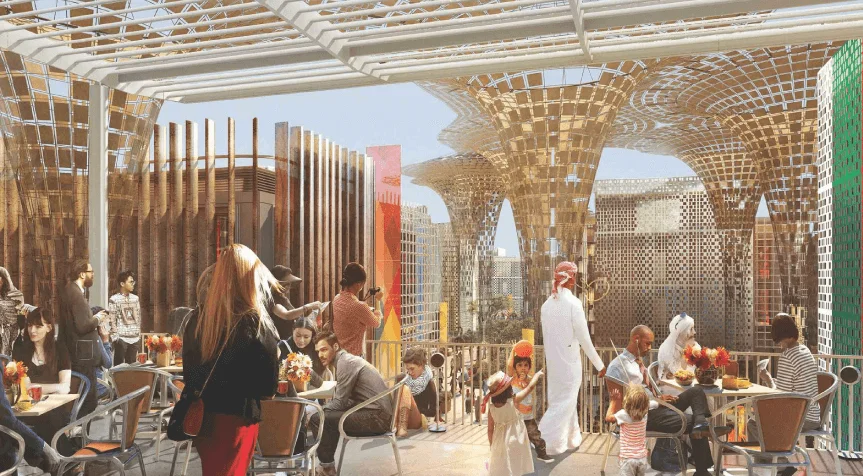
The Legacy Phase: Expo City Dubai and District 2020
One of the most distinctive aspects of Expo 2020 was the government’s explicit commitment from the outset to a meaningful post-event legacy. Unlike many World Expos that left expensive white elephant infrastructure behind, Dubai retained 80 percent of the built environment and transformed the site into a living, working urban community.
Expo City Dubai
Expo City Dubai is the renamed and repurposed successor to the Expo 2020 site. It is a mixed-use urban district designed around the principles of sustainability, innovation, and quality of life. It forms part of the Dubai 2040 Urban Master Plan and sits within the wider Dubai South development zone.
Key features of Expo City Dubai include:
- Al Wasl Plaza – the iconic dome structure at the heart of the site, used for major events and gatherings.
- Expo Village – a residential neighbourhood offering apartments and community living within the smart city environment.
- Terra – the sustainability pavilion, now a permanent exhibition and education centre for environmental science.
- Garden in the Sky – an elevated viewing experience offering panoramic views of the site.
- Dubai Exhibition Centre – a purpose-built, large-scale venue for international conferences and trade shows.
Expo City Dubai hosted COP28 in 2023, cementing its role as a global venue for high-stakes international dialogue. The site continues to be used for corporate events, government summits, cultural programmes, and public activities throughout the year. In 2026, GITEX Global – the region’s largest technology exhibition, which previously ran at the Dubai World Trade Centre – is relocating to Expo City Dubai, a significant endorsement of the site’s standing as Dubai’s primary innovation hub. Expo City has also been formally designated as the UAE’s First Green Innovation District, recognising it as a live test bed for sustainable urban technologies and practices. The Dubai Exhibition Centre is simultaneously undergoing a major expansion, scaling from its current 45,000 square metres to 122,000 square metres in 2026, with a further target of 150,000 square metres by 2027 – bringing Gulfood, Arab Health, and GITEX to the site from 2026 onwards.
District 2020 – The Business and Innovation Hub
District 2020 is the free zone and business community embedded within Expo City Dubai, specifically designed to attract companies in the fields of technology, innovation, creative industries, and sustainability. It operates as a special economic zone, offering the standard UAE free zone benefits including 100% foreign ownership, zero corporate income tax, and import/export duty exemptions.
The district has achieved strong commercial momentum. As of 2025, District 2020 had over 2,100 businesses established within the ecosystem and was reporting an 85% occupancy rate across commercial spaces – exceeding initial projections and comparing favourably with Dubai’s overall free zone occupancy average of around 76%.
Anchor tenants include global corporations such as Siemens and Accenture, which have established innovation hubs within the district. The presence of such blue-chip companies creates a gravitational pull for smaller businesses and startups that benefit from proximity, networking, and partnership opportunities.
District 2020 is particularly well suited to businesses operating in:
Expo City Dubai: Key Development Metrics (2025–2026)
| Metric | Details |
| Total Development Investment | AED 25 billion (Expo City Dubai Authority, 2026) |
| Projected Residents at Full Build-out | 25,000+ |
| Designation | UAE’s First Green Innovation District (announced 2025) |
| Dubai Exhibition Centre – 2026 Expansion | 45,000 m² scaling to 122,000 m² (Gulf News, November 2025) |
| Dubai Exhibition Centre – Target Area by 2027 | 150,000 m² |
| GITEX Global 2026 Venue | Expo City Dubai (relocating from Dubai World Trade Centre) |
| Metro Connectivity | Dubai Metro Red Line – Expo 2020 Station |
| Sources | Expo City Dubai Authority; Gulf News (November 2025); Arabian Business; Dubai Media Office |
Expo City Dubai Is Ready for Your Business
District 2020 hosts 2,100+ companies with 100% foreign ownership and direct metro access. Join a world-class innovation community.
The Long-Term Economic Contribution: What the Numbers Show
The definitive economic assessment of Expo 2020’s impact was published by Ernst and Young in March 2023. The key findings are as follows:
- Total GVA contribution to the UAE economy from 2013 to 2042 is projected at AED 154.9 billion (approximately USD 42.2 billion).
- The event phase (October 2021 to March 2022) contributed approximately 13% of the total GVA.
- The preparation phase (2013 to 2021) contributed approximately 25% of total GVA.
- The legacy phase (2022 to 2042) is expected to deliver approximately 62% of total GVA – confirming that the lasting economic value far exceeds the event itself.
- Over 1 million full-time equivalent job years are projected from 2013 to 2042, equivalent to approximately 35,000 FTE jobs per year.
The top three contributing sectors by GVA are events and business services (AED 75.5 billion), construction (AED 31.9 billion), and restaurants and hotels (AED 23.1 billion). These figures confirm that Expo 2020 was not a short-term stimulus but a platform for sustained, multi-decade economic value creation.
Trade, Investment, and International Partnerships
Beyond the quantifiable economic metrics, Expo 2020 generated significant non-quantifiable benefits that continue to compound over time. The event provided a platform for bilateral trade and investment agreements between the UAE and participating countries. National pavilions served as business-to-business networking environments, and many commercial partnerships formed during the Expo have since translated into operational business relationships.
The UAE’s profile as a global trade and investment hub was measurably enhanced by its successful hosting of the event. The country’s improved international standing as a place to do business, invest, and visit has attracted both foreign direct investment and new company formations in the years since.
The UAE’s trade diversification strategy – reducing reliance on hydrocarbons by growing sectors like tourism, financial services, logistics, and technology – received a significant boost from the credibility and visibility that Expo 2020 provided on the world stage.
Grow With UAE's Record-Breaking Trade Network
Dubai ranks No.1 globally for greenfield FDI projects. Set up your company at the centre of international commerce and investment.
Expo 2020 Legacy and Business Setup Opportunities
For entrepreneurs and investors considering UAE market entry in 2026, the Expo 2020 legacy creates tangible opportunities across several dimensions:
District 2020 and Expo City Dubai Free Zone
Companies in the technology, innovation, creative, and sustainability sectors should evaluate District 2020 as a potential base of operations. The free zone offers standard UAE free zone benefits combined with a purpose-built ecosystem of like-minded companies, access to major event infrastructure, and proximity to Al Maktoum International Airport.
Dubai South – The Broader Opportunity Zone
Expo City Dubai sits within the larger Dubai South masterplan, which encompasses logistics, aviation, residential, and commercial development across a 145-square-kilometre area. The Route 2020 Metro line connects Dubai South to the wider Dubai Metro network, improving accessibility for employees and clients. Logistics companies, e-commerce businesses, and aviation-related enterprises benefit particularly from this geography. Dubai South itself concluded 2025 with over 4,200 operational businesses – including 653 companies newly registered during the year – and a 90% retention rate among existing tenants, a 65% year-on-year rise in new business licences issued. The area’s long-term growth is anchored by the AED 128 billion (~USD 35 billion) approved expansion of Al Maktoum International Airport, which will ultimately reach a capacity of 260 million passengers annually, making it the world’s largest airport when fully completed.
Events and Business Tourism
Dubai’s position as a tier-one global events destination – reinforced by Expo 2020 and COP28 – creates ongoing commercial opportunities for hospitality, event management, professional services, and technology businesses that support the events industry. The Dubai Exhibition Centre’s forward calendar of international trade fairs and conferences provides a reliable pipeline of business activity for companies in these sectors.
Clean Energy and Sustainability
The sustainability legacy of Expo 2020 has accelerated UAE commitments to renewable energy, green building, and circular economy practices. Businesses operating in solar energy, energy efficiency, waste management, sustainable construction, and environmental consulting will find a receptive regulatory environment and growing commercial demand in the UAE market.
Dubai South and UAE Free Zone Economy: 2025 Performance Snapshot
| Metric | Data / Source |
| Total Businesses at Dubai South (End 2025) | 4,200+ (Dubai South Official, January 2026) |
| New Companies Registered in 2025 | 653 (Dubai South Official, January 2026) |
| Business Retention Rate (2025) | 90% (Dubai South Official, January 2026) |
| Growth in New Licences Issued (2025) | +65% year-on-year (Dubai South Official, January 2026) |
| Al Maktoum Airport Expansion Budget | AED 128 billion (~USD 35 billion) (UAE Media Office / Dubai Government, 2024) |
| Airport Final Passenger Capacity at Completion | 260 million annually (UAE Media Office, 2024) |
| Airport Phase 1 Capacity on Completion | 150 million annually (HH Sheikh Ahmed bin Saeed, 2024) |
| Dubai Non-Oil Free Zone Trade (2025) | AED 491 billion (~USD 133.7 billion) (DIEZ / Arabian Business, June 2026) |
| Sources | Dubai South Official Website; UAE Media Office; Dubai Integrated Economic Zones Authority (DIEZ); Arabian Business |
How Business Setup HQ Can Help
If you are considering establishing a company in the UAE – whether in Expo City Dubai, District 2020, Dubai South, or any of Dubai’s or the UAE’s other free zones and mainland jurisdictions, Business Setup HQ provides end-to-end support.
Our services include:
- Activity selection and licence type recommendation tailored to your business model.
- Trade name reservation and initial approval management.
- Document preparation and attestation guidance.
- Free zone or mainland registration and submission.
- Visa processing for investors, employees, and dependants.
- Corporate bank account introduction and support.
- Ongoing compliance and renewal management.
The UAE is one of the world’s most business-friendly environments, and the legacy of Expo 2020 continues to make it more attractive. To find out how Business Setup HQ can get your business established correctly and efficiently, contact our team today.
Frequently Asked Questions About Expo 2020 and Its Legacy
The Expo 2020 event itself concluded on 31 March 2022. However, the site has been transformed into Expo City Dubai, which operates year-round as a mixed-use urban district, events venue, and business community. It is open to visitors, residents, and businesses.
District 2020 is the business and innovation free zone within Expo City Dubai. It was established to create a lasting economic legacy from the Expo infrastructure and offers free zone company formation to businesses in technology, creative industries, sustainability, and related sectors. As of 2025, it hosts over 2,100 companies with an 85% occupancy rate.
According to the EY economic impact assessment (March 2023), the event attracted 24.1 million visits – exceeding pre-event projections. The projected total GVA contribution of AED 154.9 billion across the 2013 to 2042 lifecycle reflects a return that significantly exceeds the initial Oxford Economics estimate of AED 88 billion made at the time of the bid in 2013. The legacy phase – representing 62% of projected GVA – means the majority of economic benefits are still being realised.
The most significant post-Expo event held at the site was COP28 – the 28th United Nations Climate Change Conference – in November and December 2023. The event brought together world leaders, policymakers, and climate advocates from across the globe and was considered a landmark moment for the UAE’s environmental credibility and its international standing.
Expo City Dubai is embedded within the Dubai 2040 Urban Master Plan as one of five major urban centres planned to drive the emirate’s development over the next two decades. The plan designates Expo City Dubai as a future-focused district anchored in innovation, sustainability, and mixed-use living – fully aligned with the themes of Expo 2020 itself.
Yes. District 2020 operates as a free zone within Expo City Dubai and permits 100% foreign ownership, with no requirement for a UAE national partner or local sponsor. Entrepreneurs and investors of any nationality can establish a company in the zone, subject to standard eligibility criteria, documentation requirements, and applicable free zone fees. Both individual shareholders and corporate entities are eligible to incorporate.
Company formation costs in District 2020 vary depending on the licence category, the number of visas required, and the office space configuration selected – from flexi-desk arrangements to fully fitted private offices. Businesses should budget for trade licence fees, registration fees, and annual lease costs. Specific pricing tiers are periodically reviewed by the authority and are best confirmed directly with District 2020 or through a licensed business setup adviser. Business Setup HQ can provide current cost structures as part of a free initial consultation.
District 2020 is purpose-built around technology, innovation, sustainability, and creative industries, which distinguishes it from general-purpose zones such as DMCC – primarily suited to commodity trading and professional services – and from sector-specific zones such as Dubai Internet City and Dubai Media City. Its most distinctive advantages are its location within the broader Expo City Dubai ecosystem, access to world-class event and conference infrastructure, and the presence of major anchor tenants including Siemens and Accenture. For companies in artificial intelligence, clean technology, advanced manufacturing, digital media, or logistics innovation, District 2020 offers a community-focused environment that is difficult to replicate in other UAE free zones.